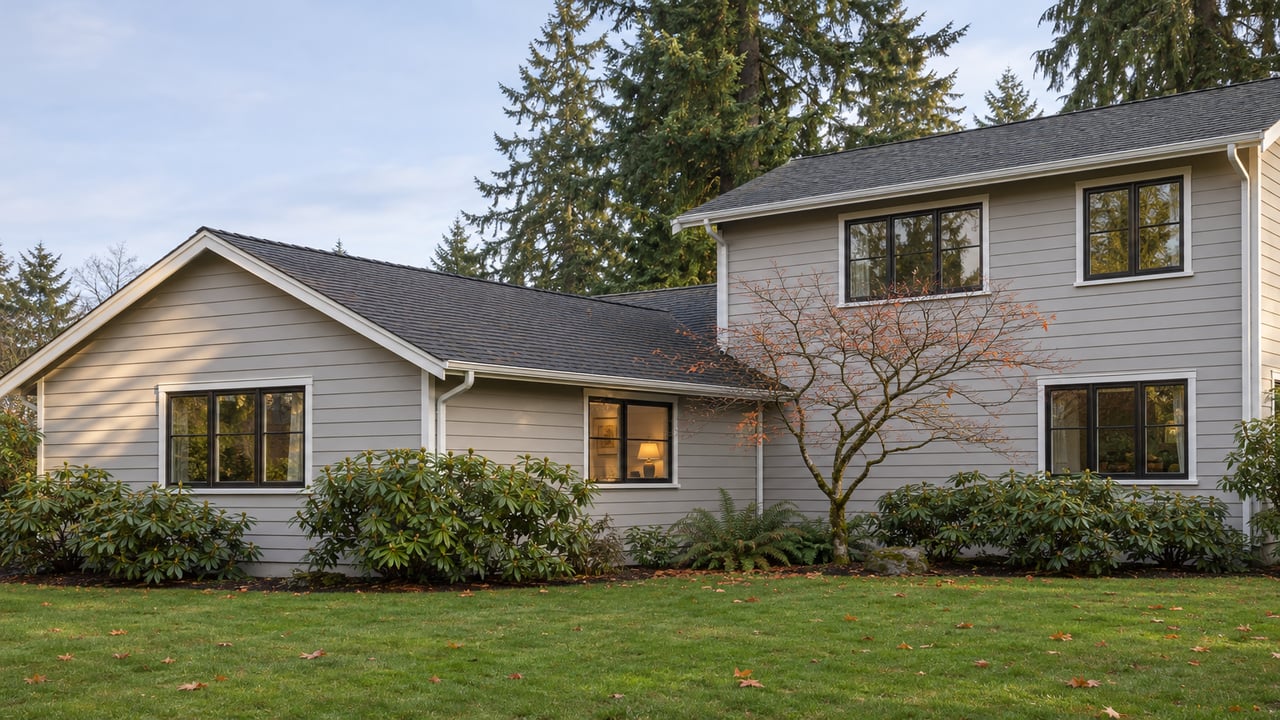
Picture a 2,100-square-foot Sammamish house with plans for a 600-square-foot addition. If most of the original exterior walls stay in place, the City of Sammamish charges no affordable housing fee. If the same project takes out more than half of those walls, the city treats it as a reconstruction. The finished 2,700-square-foot home then owes $32,727.50. That figure comes from the city's own worked example on its affordable housing regulations page, and it describes the main friction in older-home transactions on the plateau this winter.
For anyone buying an older house to rebuild, or selling one to a buyer who plans to, the walls now affect the cost of the project.
The Wall Count Behind the Bill
Sammamish's Inclusionary Affordable Housing Program, SMC Chapter 21.10, has applied since January 1, 2025. It covers new homes on vacant lots, new subdivisions and new multi-unit projects. It requires that 10% of new units be affordable to households earning up to 80% of Area Median Income. A single new house works out to one-tenth of an affordable unit. That fraction is met either by paying a fee-in-lieu or by designating the home itself as affordable.
Additions and expansions to existing homes are exempt at any size. Voluntary demolition and reconstruction is not. The line between the two comes from the city's definition of demolition in SMC 21.04.040, which the city's affordable housing regulations page applies to remodels. For a residential building, demolition means removing more than 50% of the exterior walls. A wall counts as removed when its structure comes out, when it moves to another location or elevation on the site, or when newly built space encloses it.
The enclosure clause has the widest reach. A wall can stay up and still count as removed if a large addition wraps around it. So a design that keeps the original framing but builds out in several directions can cross the 50% line.
What a Rebuild Owes, by the City's Own Arithmetic
The current rate is $34.45 per square foot of finished residential floor area. It applies only to the area above 1,750 square feet. Garages, unfinished attics, unfinished basements and upper-floor vaulted space are excluded from the count. The city publishes worked examples, and seen side by side they show where the fee lands:
| Project, per the City of Sammamish examples | Finished floor area | Fee-in-lieu |
|---|---|---|
| 1,200 sq ft addition to an existing 1,300 sq ft home | 2,500 sq ft | $0 |
| Garage and storage conversion adding 650 sq ft of living space | 3,000 sq ft | $0 |
| Home rebuilt after fire, enlarged by 800 sq ft | 4,000 sq ft | $0 |
| New home on a vacant lot | Under 1,750 sq ft | $0 |
| Voluntary teardown of a 2,100 sq ft house, rebuilt larger | 2,500 sq ft | $25,837.50 |
| 600 sq ft addition that removes more than half the exterior walls | 2,700 sq ft | $32,727.50 |
| New home with a 1,000 sq ft ADU, primary dwelling only | 3,000 sq ft | $43,062.50 |
| New home on a vacant lot | 4,000 sq ft | $77,512.50 |
The first and sixth rows end at about the same size, 2,500 and 2,700 square feet. The difference in the bill comes down to how much of the old exterior was kept. The bottom row shows the scale of the fee for a typical custom home. A 4,000-square-foot new house carries a $77,512.50 line item on top of standard permit and impact fees.
Paying the fee isn't the only option. An owner can also designate the home as affordable at 80% of Area Median Income. Affordable ownership units generally must stay affordable for at least 50 years from initial owner occupancy.
When the Money Changes Hands
The timing matters in a transaction as much as the amount. Under SMC 21.10.065:
- The obligation is calculated before building permits are issued, or before preliminary plat approval when a land division is proposed.
- Payment is due upon sale of the parcel or upon occupancy, whichever comes first.
- Fees go into a city housing trust fund that may be used only to help fund affordable housing units and reasonable administrative costs.
The second point is the one that catches people off guard. In Sammamish, a permitted rebuild that changes hands before anyone moves in reaches its payment trigger at the sale. A permitted project brings both its plans and the fee obligation they create to the closing table.
A Rate Set for a Different Formula
The current rules date from a Council vote this past summer. Ahead of that vote, Sammamish Local News reported that at the public hearing, staff called home additions the single biggest pain point at the permit center. Staff also said some applicants had canceled permits after seeing the fee. Under the original rules, a home above the threshold paid on its entire floor area.
According to that same Sammamish Local News account, no councilmember defended the program as written. The disagreement was over what the fee was meant to do. Deputy Mayor Debbie Treen moved to adopt the staff recommendation and said the fee may push longtime residents to sell to developers. Councilmember Amy Lam argued that unlimited addition exemptions favor people who already have equity in their homes. Councilmember Michael Boyer moved to charge the fee only on floor area above 1,750 square feet. Councilmember Pam Stuart noted that the $34.45 rate had been calculated on the assumption that the city would charge a home's entire floor area.
Boyer's amendment carried 5-2, and the Council kept the $34.45 rate. Mayor Josh Amato summarized his position this way, as Sammamish Local News reported:
"What we're doing now is fixing something that went too far, too fast."
The Council confirmed the changes on August 18, 2026, as Ordinance O2026-597, which took effect August 29. The final package raised the exemption threshold from 1,500 to 1,750 square feet. It also exempted additions and involuntary rebuilds, let multi-unit projects average unit sizes, and limited the fee to square footage above the threshold.
A rate designed to charge the whole house now charges only the portion above 1,750 square feet. Expanding an existing home costs nothing under this program. The remaining incentive points toward keeping walls.
Applications Filed Before the Change
Chapter 21.10 has gone through three versions since January 2025, and each one calculated the fee differently. The city's 2026 legal notices list the retroactivity interpretation under September 22, 2026. That director's interpretation covers applications submitted between January 1, 2025 and August 29, 2026. Staff first calculate the fee under the version in effect when the application came in, then apply the new exemptions, and assess whichever amount is lower. The new exemptions can reduce or eliminate an earlier obligation but cannot increase it.
This matters for any listing with permits pulled in 2025 or early 2026. The fee attached to those plans may differ from what the original paperwork shows. Sammamish Local News reported that staff said most applicants had deferred payment to final inspection. For most projects, the change removes a permit condition rather than producing a refund. The city's own announcement says applicants who already paid under the old rules may be eligible for a refund.
Where the Revenue Has Come From, and Where the City Expects It
A staff presentation reported $127,465 secured in fee-in-lieu revenue from January 2025 through April 2026, across eight projects. Six were additions or remodels and two were new single-family homes. The same slide listed 53 addition or addition-and-remodel projects and 27 new single-family projects in 2025.
Those six additions and remodels made up most of the projects that had paid, and additions are now fully exempt. Future collections will depend on new homes and teardowns. Even so, the city's proposed 2027–2028 budget projects $1,000,000 in fee-in-lieu revenue, compared with $208,000 expected for 2025–2026. The budget document calls the fee the least predictable line in its category, because it depends on the construction market and how many developers choose to pay instead of building units. The Council scheduled public hearings on the budget for November 4 and November 17.
Sammamish Local News reported that Mayor Amato and Councilmember Kent Treen both said the Council can revisit the fee once it sees results. For a project being planned this winter, the amount that applies is whatever is in the city's development fee schedule when the permit is calculated.
Frequently Asked Questions
Do ADUs trigger the fee?
ADUs of 1,750 square feet or less are exempt. In the city's example of a new 3,000-square-foot home with a 1,000-square-foot ADU, only the primary dwelling's floor area above 1,750 square feet is charged.
What about converting a large existing house into a duplex?
Units created by internally subdividing an existing structure are exempt. The city's example splits a 4,500-square-foot home into units of 2,000 and 2,500 square feet with no fee.
Does middle housing pay?
Middle housing is subject to the program. New multi-unit projects whose units average 1,750 square feet or less are exempt.
This post is general information, not legal, tax or financial advice. Confirm how the program applies to a specific property with the City of Sammamish Permit Center and your own advisors.
If you are pricing an older Sammamish home for its rebuild potential, or selling one whose next owner is likely to expand it, the condition of its exterior walls now affects the math. Brian Hopper and his team can show you how this fee fits into your sale or purchase. Request a private market strategy.